
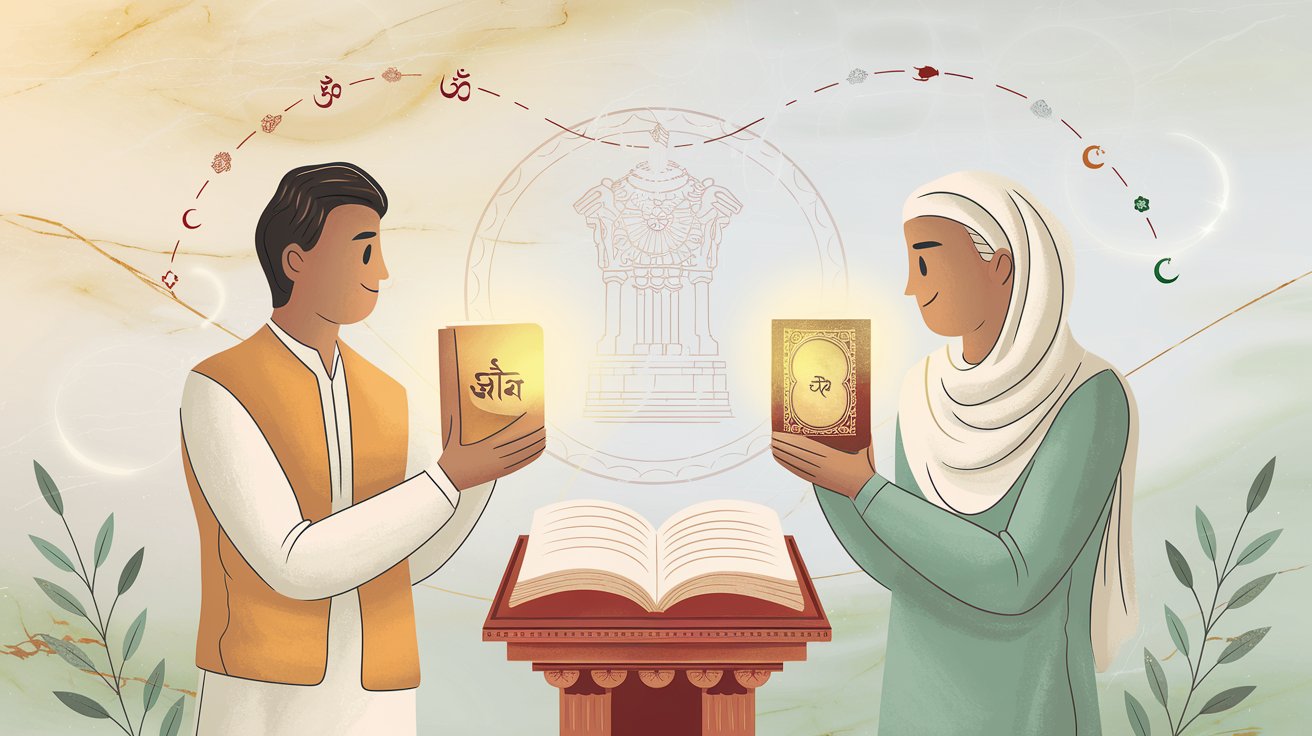
Being a Christian woman married to a Hindu man for 11 years hasn’t always been easy. I’ve faced countless questions, concerned looks, and sometimes outright criticism for my choice. People from different community often ask me as well as my parents if I am living in sin or compromising my faith. Family gatherings can become tense when religious differences arise. Yet through it all, our love has remained strong, and I’ve come to understand that interfaith relationships are far more nuanced than many religious authorities would have us believe.
Considering these questions, now I have spent ample of time researching what religious texts actually say about interfaith marriages, both to strengthen my own convictions and to respond thoughtfully to those who are questioning me and my family’s choices. What I’ve discovered has been both enlightening and affirming.
What Sin Actually Is in Christianity?
Before diving deeper into interfaith marriage, it’s important to clarify what Christianity actually defines as sin. Many who criticize my interfaith marriage seem to miss the broader understanding of sin in biblical teaching. Sin in Christianity fundamentally involves actions that separate us from God and harm ourselves or others. The Bible is quite clear about behaviors that constitute sin:
- Adultery is explicitly condemned as sin having relations with someone other than your spouse breaks the marital covenant. Jesus even expanded this understanding in Matthew 5:28, saying that looking at someone with lustful intent is also adultery in the heart.
- Abandonment of family responsibilities is considered sinful. Scripture condemns those who abandon their spouses and children (1 Timothy 5:8 states that anyone who does not provide for their relatives “has denied the faith and is worse than an unbeliever”). This includes men who leave their wives and children to pursue their own pleasures, or mothers who abandon their families for lovers.
- Hypocrisy is consistently condemned by Jesus himself. Those who present themselves as righteous Christians on social media while living contradictory private lives are engaging in the very behavior Jesus criticized in Matthew 23 when addressing religious leaders who focused on outward appearances while neglecting “justice, mercy and faithfulness.”
- Enabling wrongdoing, even when it involves one’s parents, doesn’t align with Christian teachings. While honoring parents is commanded, this doesn’t mean supporting or enabling their sinful behavior. Children who support parents who are cheating on their partners may think they’re honoring their parents, but they’re actually participating in deception.
- Judgmentalism, particularly while ignoring one’s own failings, is addressed directly by Jesus in Matthew 7:1-5. The wives of preachers who criticize others while overlooking their own shortcomings are reminded of Jesus’s words about removing the plank from one’s own eye before addressing the speck in another’s.
- Religious ostentation contradicts Jesus’s teaching in Matthew 6:1-6, where he warns against practicing faith to be seen by others. Those who flaunt their Christianity on social media for validation rather than treating faith as a personal relationship with God miss the essence of Jesus’s teaching.
What’s striking is that nowhere in these clear definitions of sin is there condemnation of respectful, loving marriages between people of different faiths. The Bible condemns unequal partnerships where values fundamentally clash, but not relationships built on mutual respect and shared ethical foundations.
What The Bible Says about Interfaith Marriages?
When people tell me my marriage contradicts biblical teaching, they typically cite passages like;
- 2 Corinthians 6:14: “Do not be unequally yoked with unbelievers. For what partnership has righteousness with lawlessness?”
- Deuteronomy 7:3-4: “You shall not intermarry with them, giving your daughters to their sons or taking their daughters for your sons, for they would turn away your sons from following me, to serve other gods.”
These passages were written in specific historical settings. The Deuteronomy instruction was specifically about the Israelites not intermarrying with Canaanite tribes who practiced things like child sacrifice and other practices considered abhorrent. The concern wasn’t about cultural differences but about being drawn away from faithful worship.
Similarly, Paul’s “unequally yoked” metaphor in Corinthians was written to a specific church facing particular challenges with paganism in their community. The emphasis was on maintaining spiritual integrity, not on prohibiting cross-cultural relationships.
What has given me particular comfort is 1 Corinthians 7:12-14, where Paul specifically addresses marriages between believers and unbelievers: “If any brother has a wife who is not a believer and she is willing to live with him, he must not divorce her.” Far from condemning such marriages, Paul acknowledges them as legitimate and advises maintaining them.
What many critics of interfaith marriage ignore are the numerous biblical examples that support cross-cultural relationships. Ruth, a Moabite woman, married Boaz, an Israelite, and became part of Jesus’s lineage. Moses married Zipporah, a Midianite woman. These weren’t just tolerated unionsthey were celebrated in scripture.
The Bible actually contains numerous examples that support cross-cultural and interfaith relationships:
- Ruth and Boaz: Ruth was a Moabite woman who married an Israelite man. Their great-grandson became King David, placing Ruth in Jesus’s lineage (Matthew 1:5-6).
- Moses and Zipporah: Moses, a central figure in Judaism, married Zipporah, a Midianite woman (Exodus 2:21).
- The Good Samaritan: Jesus held up a Samaritan (considered religiously incorrect by Jews of his time) as an exemplar of godly love (Luke 10:25-37).
- Jesus’s Great Commandment: “Love your neighbor as yourself” (Matthew 22:39) places love at the center of Christian ethics.
- Galatians 3:28: “There is neither Jew nor Greek, slave nor free, male nor female, for you are all one in Christ Jesus” emphasizing unity beyond cultural divisions.
- 1 Corinthians 7:12-14: Paul specifically addresses marriages between believers and unbelievers, saying, “If any brother has a wife who is not a believer and she is willing to live with him, he must not divorce her,” suggesting accommodation rather than prohibition.
Jesus himself repeatedly challenged religious boundaries, interacting with Samaritans, Romans, and others outside the Jewish community. His central message loving God and loving your neighbor places love at the heart of Christian ethics.
What Hindu Scriptures Says on Religious Diversity?
One aspect of Hindu faith that resonated with me from the beginning is its inherent pluralism. The Rig Veda contains the profound thoughts. Hindu texts and traditions offer a more pluralistic view that can be supportive of interfaith marriages:
- The Rig Veda contains the famous saying “Ekam Sat Vipra Bahudha Vadanti” – “Truth is one, but the wise call it by different names,” suggesting different religions are simply different paths to the same truth.
- The principle of “Vasudhaiva Kutumbakam” (the world is one family) from the Maha Upanishad emphasizes universal brotherhood transcending religious differences.
- The Bhagavad Gita (4:11) states: “In whatever way people approach Me, I reciprocate accordingly. All paths ultimately lead to Me,” suggesting divine acceptance of various religious paths.
- The concept of “Sarva Dharma Sambhava” (equal respect for all religions) is a fundamental principle in Hindu philosophy.
Traditional Hindu marriages may have their own customs and expectations, but the philosophical foundations of Hinduism include recognition that spiritual truth can be approached in multiple ways making it potentially more accommodating of interfaith relationships.
What Islam Says on Interfaith Relations?
The Quran offers guidance on interfaith relations that emphasizes respect while maintaining religious identity:
- Surah Al-Baqarah 2:256: “There shall be no compulsion in religion,” establishing religious freedom as a principle.
- Surah Al-Hujurat 49:13: “O mankind! We created you from a single soul, male and female, and made you into nations and tribes, that you may know one another.”
- Surah Al-Ma’idah 5:48: “To each among you have We prescribed a law and an open way. If God had so willed, He would have made you a single people, but (His plan is) to test you in what He has given you: so strive as in a race in all virtues.”
While traditional interpretations place certain restrictions on Muslim marriages with non-Muslims, many contemporary scholars emphasize the Quran’s broader message of respect for diversity and peaceful coexistence across religious boundaries.
What Guru Granth Sahib Says?
The Sikh holy scripture offers one of the most explicitly inclusive perspectives on religious diversity:
- Guru Granth Sahib includes writings not only from Sikh gurus but also from Hindu and Muslim saints, representing an interfaith compilation itself.
- Guru Nanak’s famous declaration: “There is no Hindu, there is no Muslim” reflects the idea that divine truth transcends religious boundaries.
- The concept of “Ik Onkar” (One God) emphasizes that the same divine reality is worshipped in different traditions.
- The Sikh concept of “Sarbat da Bhala” (welfare of all humanity) promotes universal brotherhood regardless of religious affiliation.
The Sikh tradition particularly emphasizes spiritual devotion over religious labels, suggesting that sincere faith transcends particular religious identities.
How Religious Leaders Sometimes Misinterpret Texts?
When some religious leaders suggest that interfaith marriages are sinful, they may be:
- Reading Selectively:
Taking specific verses without considering their historical context or the broader biblical message of love and inclusion.
- Confusing Cultural Traditions with Religious Requirements:
Many religious communities have cultural preferences that have become intertwined with religious practices but aren’t actually doctrinal requirements.
- Focusing on Religious Preservation:
Some leaders worry about maintaining community cohesion and religious continuity, especially in minority religious communities.
- Applying Ancient Instructions to Modern Situations:
Biblical instructions about not intermarrying with Canaanites or Philistines addressed specific historical concerns about idolatry and child sacrifice, not modern interfaith marriages based on mutual respect.
- Overlooking the Centrality of Love:
Jesus consistently placed love at the center of Christian ethics, suggesting that loving relationships fulfill rather than violate divine intention.
These misinterpretations often neglect the broader themes of compassion, love, and acceptance found across all major religious traditions.
Constitutional Framework in India
India’s legal system strongly supports religious freedom and interfaith marriages:
Constitutional Protections for Religious Freedom
- Article 25: Guarantees freedom of conscience and the right to freely profess, practice, and propagate religion.
- Article 26: Provides freedom to manage religious affairs according to one’s own traditions.
- Article 51A(e): Promotes harmony and brotherhood among all people, transcending religious divisions.
- Articles 14 and 15: Guarantee equality before law and prohibit discrimination on grounds of religion.
Special Marriage Act, 1954
This legislation was specifically created to enable interfaith marriages without requiring either spouse to convert. It provides a legal framework that:
- Recognizes marriages between people of different faiths
- Doesn’t require religious conversion
- Ensures inheritance rights and other legal protections
- Preserves both individuals’ religious identities
Legal Implications of Religious Misrepresentation
When religious leaders spread misinformation about other religions or condemn interfaith marriages without constitutional basis:
- This may potentially violate laws against hate speech
- Under the Indian Penal Code (Sections 153A and 295A), promoting enmity between religious groups or deliberately outraging religious feelings is punishable
- The Information Technology Act addresses the spread of false information online that could disturb religious harmony
India’s secular constitution creates a framework where citizens are free to practice their faith while respecting others’ right to do the same.
My Personal Journey
As a Christian woman married to a Hindu man for 11 years, my marriage represents a personal choice that deserves respect and understanding. Here’s how I think about my situation from a faith perspective:
- The Primacy of Love: Jesus identified love as the greatest commandment (Matthew 22:36-40). A loving, respectful marriage honors this principle regardless of religious differences.
- The Example of Ruth: The Book of Ruth celebrates a Moabite woman (not an Israelite) who married into a Jewish family. Ruth’s famous declaration, “Your people will be my people and your God my God” (Ruth 1:16) shows respect across faith boundaries. Ruth became the great-grandmother of King David and is mentioned in Jesus’s genealogy.
- Paul’s Guidance on Mixed Marriages: In 1 Corinthians 7:12-14, Paul specifically addresses marriages between believers and unbelievers, stating: “If any brother has a wife who is not a believer and she is willing to live with him, he must not divorce her. And if a woman has a husband who is not a believer and he is willing to live with her, she must not divorce him. For the unbelieving husband has been sanctified through his wife, and the unbelieving wife has been sanctified through her believing husband.”
- Unity in Christ: Galatians 3:28 states, “There is neither Jew nor Gentile, neither slave nor free, nor is there male and female, for you are all one in Christ Jesus.” This suggests that in Christ, cultural and religious divisions are transcended.
- Faith, Hope and Love: 1 Corinthians 13:13 reminds us, “And now these three remain: faith, hope and love. But the greatest of these is love.” A marriage grounded in love fulfills this highest Christian value.
- Fruits of the Spirit: Galatians 5:22-23 identifies the fruits of the Spirit as “love, joy, peace, forbearance, kindness, goodness, faithfulness, gentleness and self-control.” A marriage that demonstrates these qualities reflects Christian values regardless of religious differences.
Conclusion
Religious texts contain varied messages about interfaith relationships, but their broader themes typically emphasize universal values like compassion, understanding, and respect. When examined closely, biblical passages often used to discourage interfaith marriages were addressing specific historical contexts, while the overarching message emphasizes love and unity.
In India, the constitution rightly protects religious freedom while establishing a framework for peaceful coexistence among different faiths. My marriage represents this constitutional ideal in practice.
The question of whether interfaith marriage is “sinful” reflects a narrow interpretation that doesn’t capture the complexity and richness of religious traditions. What truly matters in any relationship is mutual respect, love, and shared values qualities that transcend religious boundaries.
After 11 years, I can confidently say that interfaith marriage hasn’t diminished my Christian faith but has deepened it. Our relationship stands as testament to the possibility of harmony across religious boundaries, reflecting both India’s constitutional values and the higher spiritual principles that are central to all major religious traditions, including Christianity.
Rather than asking if interfaith marriages are permissible, perhaps we should ask if they can embody the highest values of our respective traditions. In our case, and in many others I’ve encountered, the answer is a resounding yes.