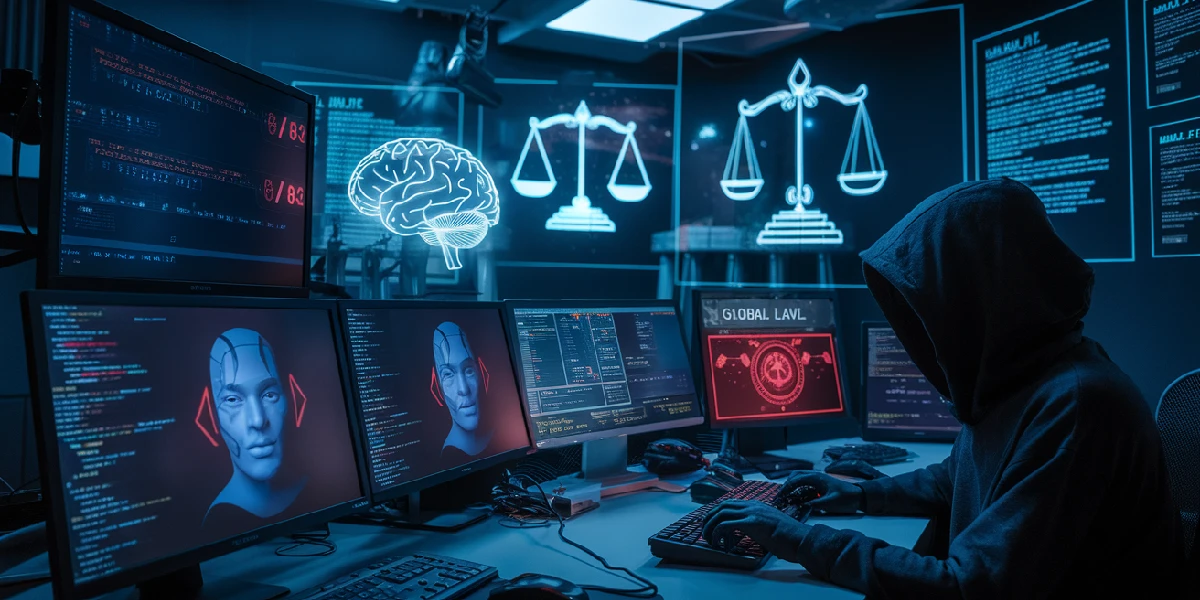
Artificial intelligence has emerged as a transformative force in the digital age, offering unprecedented capabilities in automation, analysis, and decision-making. However, this technological revolution presents a paradox that defines our contemporary cybersecurity landscape. While AI in cybersecurity has strengthened defensive mechanisms through advanced threat detection and response systems, the same technologies have become powerful weapons in the hands of malicious actors.
The democratization of AI tools has fundamentally altered the threat landscape, enabling sophisticated attacks that were once the exclusive domain of state-sponsored groups or highly skilled cybercriminals. Today’s cyber security privacy concerns extend far beyond traditional data breaches, encompassing AI-generated synthetic media, automated social engineering attacks, and machine learning-powered vulnerability exploitation. This dual nature of AI technology necessitates a comprehensive examination of how legal frameworks are evolving to address these emerging threats while preserving innovation potential.
2. Understanding Generative AI in Cybercrime
Generative AI has revolutionized cybercrime by lowering barriers to entry and amplifying attack capabilities. Large language models like GPT-based systems are being exploited to create convincing phishing emails, generate malicious code, and conduct social engineering attacks at scale. These tools can analyze target organizations’ communication patterns, creating personalized attack vectors that bypass traditional security awareness training.
The sophistication of AI in cybersecurity threats extends to automated vulnerability discovery and exploit generation. Machine learning algorithms can now scan codebases for zero-day vulnerabilities faster than human security researchers, while AI-powered botnets adapt their behavior to evade detection systems. Cybercriminals are leveraging these capabilities to launch coordinated attacks that combine multiple AI-generated components, from initial reconnaissance to payload delivery.
Furthermore, the accessibility of AI tools through cloud platforms and open-source repositories has democratized advanced attack techniques. Criminal organizations no longer require extensive technical expertise to conduct sophisticated operations, as AI systems can automate complex tasks like password cracking, network reconnaissance, and even the creation of custom malware variants.
3. Data Privacy in Cyber Security: An Escalating Concern
The intersection of AI and cybercrime has intensified data privacy in cyber security challenges across multiple dimensions. AI-enhanced attacks can process vast amounts of personal data to identify high-value targets, predict user behavior, and craft personalized attack strategies. This capability transforms data breaches from opportunistic events into precisely targeted operations that can extract maximum value from compromised information.
Modern cybercriminals employ machine learning algorithms to analyze stolen datasets, identifying patterns that enable identity theft, financial fraud, and corporate espionage. The volume and velocity of data processing capabilities mean that even seemingly insignificant personal information can be weaponized through AI analysis. Data privacy information security frameworks struggle to keep pace with these evolving threats, as traditional anonymization techniques prove inadequate against AI-powered de-anonymization attacks.
The challenge is further compounded by the global nature of data flows and the jurisdictional complexities of cyber security privacy regulations. Personal data stolen in one country may be processed by AI systems in another jurisdiction, creating enforcement gaps that cybercriminals exploit. This transnational dimension of AI-enabled cybercrime requires unprecedented cooperation between regulatory bodies and law enforcement agencies.
4. AI Deepfakes and Synthetic Identity Theft
The proliferation of deepfake technology represents one of the most visible manifestations of AI deepfake law regulation challenges. Synthetic media generation has evolved from requiring specialized equipment and expertise to being accessible through consumer-grade applications. This accessibility has enabled new forms of cybercrime, including CEO fraud, romantic scams, and political disinformation campaigns.
AI deepfake law regulation faces unique challenges due to the technology’s dual-use nature. While deepfakes can be used for legitimate purposes such as entertainment and education, the same technology enables sophisticated impersonation attacks that can bypass biometric security systems and conduct real-time voice manipulation during phone calls. The psychological impact of deepfake technology extends beyond immediate financial losses, eroding trust in digital communications and authentic media.
Synthetic identity theft, powered by AI-generated personas, has emerged as a particularly insidious form of cybercrime. These AI-created identities can maintain consistent online presence across multiple platforms, building credibility over time before launching targeted attacks. The sophistication of these synthetic identities makes them nearly indistinguishable from authentic profiles, challenging traditional verification methods and data privacy in cyber security protocols.
5. Global Regulatory Response
EU Regulations
The European Union has taken a comprehensive approach to addressing AI-enabled cybercrime through multiple regulatory frameworks. The EU AI Act, implemented in 2024, establishes a risk-based approach to AI regulation, categorizing AI systems by their potential harm to individuals and society. High-risk AI applications, including those used in cybersecurity contexts, face stringent requirements for transparency, accuracy, and human oversight.
The General Data Protection Regulation (GDPR) continues to serve as a cornerstone of data privacy information security in the EU, with recent enforcement actions demonstrating its applicability to AI-powered attacks. The regulation’s principles of data minimization and purpose limitation provide crucial protections against AI systems that process personal data for malicious purposes. However, the cross-border nature of AI-enabled cybercrime has tested the limits of GDPR’s territorial scope and enforcement mechanisms.
The EU’s Digital Services Act complements these frameworks by imposing obligations on platforms to detect and remove AI-generated harmful content, including deepfakes used for cybercrime. This multi-layered approach reflects the EU’s recognition that AI deepfake law regulation requires coordination across multiple legal domains.
United States Legal Framework
The United States has adopted a more fragmented approach to AI in cybersecurity regulation, with federal agencies developing sector-specific guidance while states implement their own privacy laws. The National Institute of Standards and Technology (NIST) AI Risk Management Framework provides voluntary guidelines for organizations developing and deploying AI systems, including those used in cybersecurity applications.
Federal agencies have begun adapting existing cybersecurity regulations to address AI-specific threats. The Cybersecurity and Infrastructure Security Agency (CISA) has issued guidance on securing AI systems against adversarial attacks, while the Federal Trade Commission has emphasized that existing consumer protection laws apply to AI-enabled fraud and deception.
State-level initiatives have focused primarily on data privacy in cyber security, with laws like the California Consumer Privacy Act (CCPA) providing templates for other states. However, the lack of federal legislation specifically addressing AI deepfake law regulation has created a patchwork of state laws with varying levels of protection and enforcement capabilities.
India’s Legislative Measures
India’s approach to AI governance reflects the country’s position as both a major technology developer and a target of AI-enabled cybercrime. The Digital Personal Data Protection Act (DPDP) 2023 establishes comprehensive data protection requirements that extend to AI systems processing personal data. The act’s emphasis on consent and data minimization provides crucial protections against AI-powered attacks that rely on extensive personal data collection.
The Computer Emergency Response Team (CERT-In) has issued specific guidelines for securing AI systems against cyberattacks, recognizing the unique vulnerabilities introduced by machine learning algorithms. These guidelines address both the use of AI in cybersecurity defense and the protection of AI systems themselves from malicious exploitation.
India’s upcoming AI policy framework is expected to address AI deepfake law regulation more comprehensively, drawing from international best practices while addressing the specific challenges faced by developing economies. The policy development process has emphasized stakeholder consultation and alignment with existing cyber security privacy regulations.
6. Challenges in Enforcement & Ethical Dilemmas
The enforcement of AI-related cybercrime laws faces unprecedented technical and jurisdictional challenges. Traditional law enforcement agencies often lack the specialized expertise required to investigate AI-enabled crimes, while the rapid pace of technological development outpaces regulatory adaptation. The global nature of AI infrastructure means that cybercriminals can exploit jurisdictional gaps by distributing their operations across multiple legal systems.
Attribution challenges in AI-enabled cybercrime create additional enforcement difficulties. When attacks are generated or enhanced by AI systems, determining the responsible parties becomes complex, particularly when multiple AI tools and platforms are involved. This complexity is compounded by the potential for AI systems to operate autonomously, raising questions about liability and responsibility in cyber security privacy violations.
Ethical dilemmas emerge when defensive AI systems in cybersecurity begin to mirror the techniques used by attackers. The development of AI systems capable of generating synthetic identities for honeypot operations or creating deepfakes to deceive cybercriminals raises questions about the appropriate boundaries of defensive cybersecurity measures. These ethical considerations become particularly acute when considering the potential for mission creep in AI-powered surveillance and monitoring systems.
7. Future Outlook: Strengthening Data Privacy & AI Governance
The future of AI governance in cybersecurity will require unprecedented international cooperation and technical innovation. Emerging technologies like differential privacy and federated learning offer potential solutions for preserving data privacy in cyber security while enabling beneficial AI applications. However, these technical solutions must be supported by robust legal frameworks that can adapt to rapid technological change.
Regulatory sandboxes and controlled testing environments are becoming essential tools for developing AI in cybersecurity policies that balance innovation with security. These approaches allow regulators to observe AI system behavior in controlled settings while providing guidance to developers on compliance requirements. The lessons learned from these environments will be crucial for developing scalable regulatory approaches.
The development of AI auditing and certification frameworks will become increasingly important as AI systems become more prevalent in cybersecurity applications. These frameworks must address both the security of AI systems themselves and their potential for misuse in cybercrime. International standards organizations are working to develop common criteria for AI security assessment, though significant work remains to achieve global consensus.
8. Conclusion: Bridging Innovation with Regulation
The rise of AI in cybercrime represents one of the most significant challenges facing modern society, requiring coordinated responses from technologists, policymakers, and law enforcement agencies. The dual nature of AI technology means that regulatory approaches must carefully balance the prevention of harmful applications with the preservation of beneficial innovation.
Current regulatory frameworks, while providing important foundations, require significant evolution to address the unique challenges posed by AI-enabled cybercrime. The global nature of these threats necessitates unprecedented international cooperation, while the rapid pace of technological development demands more agile regulatory processes. Data privacy in cyber security must be reconceptualized to account for the sophisticated analytical capabilities of AI systems, moving beyond traditional concepts of anonymization and consent.
The effectiveness of AI deepfake law regulation will ultimately depend on the development of technical solutions that can detect and prevent malicious synthetic media while preserving legitimate uses of the technology. This requires ongoing collaboration between the private sector, academic researchers, and government agencies to stay ahead of evolving threats.
As we move forward, the success of AI governance in cybersecurity will be measured not only by the prevention of criminal activity but also by the preservation of trust in digital systems and the protection of fundamental rights in an AI-enabled world. The challenge lies in creating regulatory frameworks that are both technically informed and ethically grounded, capable of adapting to future technological developments while maintaining consistent principles of privacy, security, and human dignity.
The path forward requires acknowledging that AI in cybersecurity is not merely a technical challenge but a fundamental question of how we choose to organize and protect our digital society. The decisions made today regarding AI governance will shape the cybersecurity landscape for generations to come, making it essential that these decisions reflect both technical expertise and societal values.