
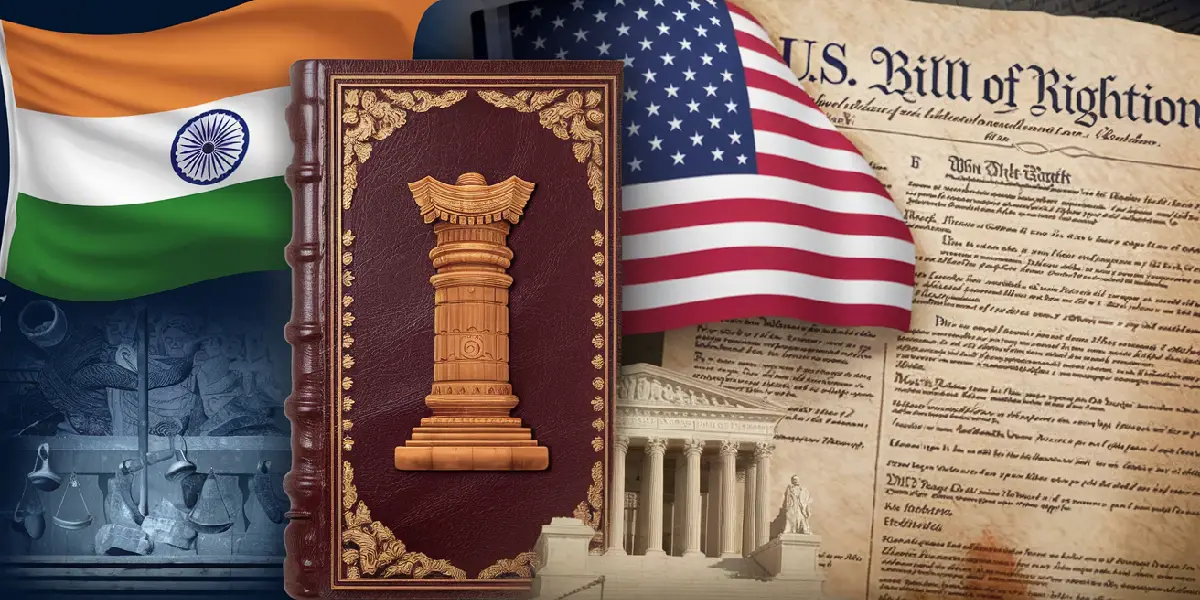
The architecture of constitutional rights reveals the deepest philosophical assumptions about human nature, state authority, and the delicate balance between individual freedom and collective welfare. When we examine India’s Fundamental Rights alongside America’s Bill of Rights, we encounter two distinct approaches to this eternal tension one forged in the crucible of colonial liberation and social transformation, the other born from rebellion against monarchical overreach and refined through centuries of jurisprudential evolution.
These documents, separated by nearly two centuries, represent more than legal frameworks; they embody fundamentally different visions of what it means to be free in an organized society. While the American Bill of Rights emerged as a bulwark against government interference, India’s Fundamental Rights were conceived as both shield and sword protecting individual dignity while actively dismantling centuries of social stratification.
Historical Genesis: Context Shapes Content
The American Bill of Rights, ratified in 1791, emerged from the Founders’ acute awareness of governmental tyranny. Having experienced the arbitrary exercise of power under British rule, the framers crafted amendments designed primarily as negative rights limitations on what government could do to individuals. The First Amendment’s declaration that “Congress shall make no law” exemplifies this philosophy of constitutional restraint.
India’s approach, crystallized in 1950, reflected a different historical moment and imperative. The framers, led by Dr. B.R. Ambedkar, confronted not just the need to limit state power but to actively reconstruct a society fractured by centuries of caste-based discrimination, colonial exploitation, and religious division. The Constitution thus embraces both negative rights (prohibitions on state action) and positive rights (entitlements requiring state action), creating what constitutional scholar Granville Austin termed a “seamless web” between individual liberty and social transformation.
The Architecture of Protection: Scope and Structure
American Minimalism vs. Indian Comprehensiveness
The US Bill of Rights comprises ten amendments focused primarily on procedural protections and limitations on federal power. Its elegance lies in brevity—the First Amendment’s 45 words have generated volumes of jurisprudence while maintaining their essential clarity. This minimalist approach reflects the American preference for leaving maximum space for democratic deliberation and judicial interpretation.
India’s Fundamental Rights, spanning Articles 12-35, present a more elaborate framework. Beyond traditional civil liberties, they encompass economic and social rights, including the right against exploitation (Article 23-24) and cultural and educational rights (Articles 29-30). This comprehensive approach reflects India’s commitment to what Dr. Ambedkar called “constitutional morality” the idea that fundamental rights must address not just political freedom but human dignity in its broadest sense.
The Question of Justiciability
A crucial distinction emerges in enforcement mechanisms. American constitutional rights enjoy robust judicial protection, with the Supreme Court wielding the power of judicial review to strike down legislative and executive actions. The Court’s role as the ultimate arbiter of constitutional meaning has remained largely uncontested since Marbury v. Madison (1803).
India’s system introduces greater complexity through the distinction between Fundamental Rights (justiciable) and Directive Principles of State Policy (non-justiciable guidelines for governance). This reflects the framers’ recognition that while courts can protect negative rights effectively, positive rights often require legislative and executive action beyond judicial competence. The tension between these two parts has generated decades of constitutional dialogue about the proper role of courts in social transformation.
Philosophical Foundations: Liberty vs. Justice
Individual Autonomy vs. Social Harmony
The American conception of rights rests heavily on John Stuart Mill’s harm principle and classical liberal notions of individual autonomy. The presumption favors individual choice, with state intervention justified only when actions harm others. This philosophy underlies the broad protection of speech, even when offensive, and the strong presumption against government regulation of private conduct.
India’s approach reflects a more communitarian understanding of rights, influenced by both ancient Indian philosophical traditions and modern socialist thought. The Constitution explicitly recognizes that individual rights exist within social contexts and may require limitation for the greater good. Article 19, while guaranteeing freedom of speech and expression, allows restrictions in the interests of “public order, decency or morality,” reflecting a more contextual approach to individual liberty.
Equality: Formal vs. Substantive
Perhaps nowhere is the philosophical difference more stark than in approaches to equality. The American system, rooted in the Fourteenth Amendment’s Equal Protection Clause, has evolved toward a formal equality model treating likes alike regardless of historical disadvantage. While this has enabled significant progress in areas like racial integration, it has also limited the state’s ability to remedy past discrimination through affirmative action.
India’s Constitution embraces substantive equality, explicitly authorizing affirmative action for historically disadvantaged groups. Articles 15(4) and 16(4) permit special provisions for Scheduled Castes, Scheduled Tribes, and Other Backward Classes, reflecting the framers’ understanding that formal equality cannot address centuries of systematic exclusion. This approach has enabled the world’s most extensive affirmative action program while generating ongoing debates about merit, representation, and social justice.
Contemporary Challenges: Rights in the Digital Age
Privacy and Surveillance
The digital revolution has tested both systems’ ability to adapt foundational principles to new realities. The American approach, with its strong Fourth Amendment protections against unreasonable searches, has struggled to address digital surveillance that doesn’t fit traditional notions of physical intrusion. The Supreme Court’s decisions in cases like Carpenter v. United States (2018) reflect ongoing efforts to apply 18th-century principles to 21st-century technologies.
India’s journey toward recognizing privacy as a fundamental right culminated in the landmark Puttaswamy judgment (2017), which declared privacy essential to human dignity and personal autonomy. This judicial recognition, absent explicit constitutional text, demonstrates the Indian Supreme Court’s willingness to evolve constitutional interpretation to meet contemporary needs an approach that would be more constrained under American constitutional methodology.
Economic Rights and Social Welfare
The COVID-19 pandemic highlighted different approaches to economic rights. While American constitutional law provides limited protection for economic entitlements, focusing instead on procedural fairness in government benefit programs, India’s Directive Principles envision a welfare state with positive obligations to ensure adequate livelihood, healthcare, and education.
This difference manifests in judicial approaches to economic policy. American courts generally defer to legislative judgment on economic matters, while Indian courts have increasingly recognized justiciable dimensions of economic rights, particularly when they connect to fundamental rights like life and dignity.
The Balance of Power: Federalism and Rights
State vs. Federal Authority
The American federal system creates complex interactions between national and state authority over rights. While the Bill of Rights originally constrained only federal action, the Fourteenth Amendment’s incorporation doctrine has gradually applied most protections to state governments. However, states retain significant authority over areas like criminal law, education, and family relations, creating variation in rights protection across jurisdictions.
India’s federal structure operates differently, with Fundamental Rights binding all levels of government uniformly. The Constitution’s detailed enumeration of central and state powers, combined with the Union’s residuary authority, creates less space for variation in rights protection. This reflects the framers’ concern that a truly federal approach might perpetuate regional disparities in rights enforcement.
Emergency Powers and Constitutional Suspension
Both systems grapple with the tension between rights and security, but their approaches differ significantly. The American system lacks explicit emergency provisions, relying instead on implied presidential powers during crises. This has led to historical abuses from Lincoln’s suspension of habeas corpus to Japanese American internment that later generations have condemned but which faced limited constitutional constraint at the time.
India’s Constitution explicitly provides for emergency powers under Articles 352-360, including the controversial provision allowing suspension of Fundamental Rights during national emergencies. The experience during the 1975-77 Emergency, when most Fundamental Rights were suspended, led to the 44th Amendment restricting these powers. This explicit constitutional treatment of emergencies provides clearer boundaries but also legitimizes extraordinary measures in ways the American system does not.
Judicial Philosophy: Activism vs. Restraint
Interpretive Methodologies
American constitutional interpretation remains divided between originalists, who seek to apply the text’s original public meaning, and living constitutionalists, who emphasize evolutionary interpretation. This methodological debate shapes outcomes across the spectrum of rights, from gun rights to abortion to religious freedom.
Indian constitutional interpretation has embraced a more explicitly evolutionary approach, with the Supreme Court’s “basic structure” doctrine preventing amendments that would destroy the Constitution’s essential identity while allowing adaptation to changing circumstances. This has enabled transformative interpretations, such as recognizing environmental rights within the right to life, while maintaining constitutional continuity.
The Role of International Law
Indian courts have shown greater willingness to incorporate international human rights norms into constitutional interpretation, treating international law as a source of guidance in understanding fundamental rights. American courts, by contrast, have been more resistant to international influences, with some justices arguing that foreign law should play no role in constitutional interpretation.
This difference reflects broader attitudes toward sovereignty and legal pluralism. India’s post-colonial experience has fostered greater comfort with drawing from multiple legal traditions, while American exceptionalism has emphasized the uniqueness of the constitutional tradition.
Contemporary Debates: Rights in Tension
Religious Freedom vs. Secular Governance
Both systems struggle with balancing religious freedom against secular governance principles, but their approaches reflect different church-state relationships. The American system’s Establishment Clause creates a wall of separation that can sometimes conflict with the Free Exercise Clause, generating ongoing tension between religious accommodation and secular neutrality.
India’s approach to secularism permits greater state engagement with religion while prohibiting discrimination. The Constitution protects religious freedom broadly while allowing the state to regulate religious practices that conflict with other fundamental rights. This has enabled legislation addressing practices like triple talaq while maintaining religious autonomy in matters of faith and worship.
Free Speech vs. Social Harmony
The contrast in free speech protection illustrates different balancing approaches. American First Amendment jurisprudence provides broad protection even for offensive speech, with content-based restrictions subject to strict scrutiny. The marketplace of ideas theory assumes that truth emerges through open debate, even when that debate includes harmful falsehoods.
Indian free speech jurisprudence, while robust, more readily accepts restrictions for maintaining social harmony and public order. The Constitution’s explicit allowance for speech restrictions based on “public order, decency or morality” reflects a more communitarian approach that weighs individual expression against social cohesion.
The Global Influence: Exporting Constitutional Models
American Constitutional Export
The American Bill of Rights has influenced constitutional development worldwide, with many nations adopting similar protections for speech, religion, and due process. The American emphasis on judicial review and constitutional supremacy has become a global norm, though often adapted to local contexts.
However, the American model’s emphasis on negative rights and limited government has proven less transferable to societies facing different challenges. Post-colonial nations often require more active state involvement in addressing historical inequities, making India’s model more relevant.
India’s Constitutional Contribution
India’s Constitution has increasingly influenced constitutional development in other diverse democracies. The combination of fundamental rights with directive principles, the recognition of group rights alongside individual rights, and the explicit commitment to affirmative action have provided models for other nations grappling with similar challenges.
The Indian approach to constitutional interpretation, emphasizing the basic structure doctrine and evolutionary adaptation, has influenced courts from Ireland to Bangladesh, offering an alternative to both rigid originalism and unconstrained judicial activism.
Looking Forward: Rights in an Interconnected World
Digital Rights and Global Governance
As technology transcends national boundaries, both systems face challenges in protecting rights in digital spaces. The Indian approach to data protection, emphasizing both individual privacy and collective data sovereignty, offers insights for other nations seeking to balance personal rights with national security in an interconnected world.
The American emphasis on private sector innovation, constrained primarily by market forces rather than comprehensive regulation, presents a different model that prioritizes economic freedom while potentially sacrificing individual privacy and democratic governance.
Climate Change and Intergenerational Rights
Both systems increasingly confront questions of intergenerational justice and environmental rights. Indian courts have recognized environmental protection as implicit in the right to life, enabling expansive judicial intervention to protect ecological integrity. American courts have been more hesitant to recognize environmental rights, though some state constitutions have moved in this direction.
The challenge of climate change may require both systems to evolve their understanding of rights to encompass collective survival and intergenerational responsibility—areas where traditional individual rights frameworks provide limited guidance.
Conclusion: Complementary Visions of Human Dignity
The comparison between India’s Fundamental Rights and America’s Bill of Rights reveals not competing failures but complementary approaches to the eternal challenge of organizing free societies. The American emphasis on limiting government power and maximizing individual autonomy has created space for innovation, expression, and personal development while sometimes failing to address systemic inequalities and collective challenges.
India’s more comprehensive approach, embracing both individual rights and collective responsibilities, has enabled dramatic social transformation while sometimes limiting individual autonomy in service of social harmony. Neither system has achieved perfect justice, but both have advanced human dignity within their particular contexts and constraints.
Perhaps the greatest lesson from this comparison is that constitutional rights cannot be divorced from the societies they serve. The American Bill of Rights reflects the genius of limiting government in a society with relatively homogeneous founding populations and abundant resources. India’s Fundamental Rights reflect the wisdom of active constitutionalism in a diverse society requiring deliberate reconstruction of social relationships.
As both nations face new challenges from technological disruption to climate change to rising inequality they may find wisdom in each other’s approaches. The American system’s emphasis on procedural fairness and individual autonomy offers valuable protections against majoritarian excess, while India’s commitment to substantive equality and collective welfare provides tools for addressing systemic injustice.
The ultimate measure of any constitutional system is not its theoretical elegance but its practical success in enabling human flourishing. Both the American Bill of Rights and India’s Fundamental Rights have enabled their societies to advance toward greater justice, though neither has achieved the full promise of human dignity. Their ongoing evolution, influenced by each other and the broader global conversation about rights, offers hope for continued progress toward the elusive goal of a truly free and just society.
In our interconnected world, constitutional rights increasingly transcend national boundaries. The American commitment to free expression and due process and the Indian emphasis on equality and social justice both contribute to the global understanding of human rights. Rather than viewing these as competing models, we might see them as complementary contributions to humanity’s ongoing experiment in self-governance each offering insights that can strengthen the other in service of our common aspiration for dignity, freedom, and justice.